
Priced Out of the Game
Once a cornerstone of working-class entertainment, professional sports are increasingly becoming inaccessible to the very fans who built them.
- Ticket fees. Parking. Concessions.
- Merchandise.
- And now Streaming subscriptions.
The cost of being a fan has never been higher.
My family lives in the Twin Cities, and we’re big sports fans. Throughout the year, we’re following the Twins, Wild, Timberwolves, Lynx, and Frost. And like many Minnesota families, cheering for our hometown teams has always been something that brings us together.
Lately, though, We’ve noticed something troubling. Following the teams we love is becoming increasingly expensive. For example, almost all of the Games that used to be included with cable now require separate streaming subscriptions. Attending games means paying not only for tickets, but also parking, concessions, merchandise, and a growing list of fees, and they seem ever increasing.
So, I decide to do a little digging, and the more I looked into the rising cost of being a sports fan, the more I realized this isn’t just a sports story. These costs are part of a much larger conversation about affordability, accessibility, and the growing financial pressures facing working-class and middle-class families across America.
Sports Used to Be a Community Experience

From Community Tradition to Luxury Product
Teams built generations of loyal fans because access came first and profit maximization came second.
- Local Broadcasts
- Free Over-The-Air TV
- Affordable upper-deck tickets
- Family outings
- Neighborhood discussions centered around local teams
The commercialization of sports is creating a new barrier to participation for working-class families, even though sports have historically been one of the few cultural institutions that united people across income levels.
In This Article
The New Costs of Being a Fan
As I started looking at what it actually costs my family to follow our favorite Minnesota teams, I realized the ticket price is often the smallest part of the bill.
Being a fan today isn’t just about buying a ticket or turning on the television. It’s a growing collection of subscriptions, fees, surcharges, and add-on costs that can quietly add hundreds or even thousands of dollars to a family’s.
“Most families don’t notice these costs all at once. They notice them one subscription, one fee, and one price increase at a time.”
A Day at the Game
The true cost of attending a professional sporting event goes well beyond admission. This breakdown shows how ticket fees, concessions, parking, and merchandise can dramatically increase the final bill for a family of four.
Here’s how the costs stack up across professional sports leagues.
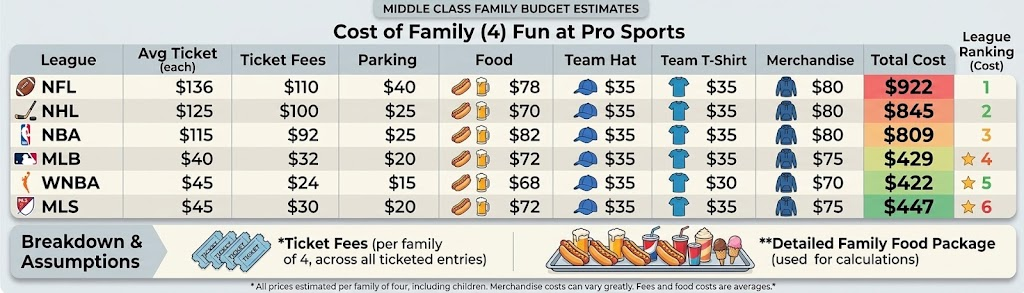
For many fans, the most frustrating part isn’t even the ticket price itself. Broker markups, resale speculation, and hidden fees can transform an affordable event into an expensive one.
In the next section, we’ll look at how ticket brokers and fee structures have fundamentally changed the cost of attending live sports.
The Rise of “Additional Fees”
Consumer complaints about ticket fees have become so widespread that the Federal Trade Commission adopted rules requiring ticket sellers to display total prices upfront rather than surprising consumers at checkout. The agency described hidden ticket fees as a form of deceptive pricing that makes it difficult for consumers to compare costs and budget accurately. More than 60,000 public comments were submitted during the rule making process. Federal Trade Commission, Federal Trade Commission
According to the FTC:
Consumers shopping for live-event tickets should no longer be surprised by a pile of “service,” “convenience,” or other mandatory fees added late in the buying process. Federal Trade Commission, Federal Trade Commission
Because of the fact that federal regulators felt compelled to intervene speaks volumes about how common these practices have become.
The Hidden Tax: Ticket Fees and Ticket Brokers
When most fans see a ticket advertised for $70, they reasonably assume they’ll pay somewhere close to $70.
Instead, many discover a very different reality at checkout:
| Cost | Amount |
|---|---|
| Ticket Price | $70 |
| Service Fee | $22 |
| Facility Fee | $8 |
| Processing Fee | $5 |
| Total | $105 |
That same ticket can then appear on a resale marketplace for $150, $200, or even $250, often before the average fan has had a fair chance to purchase it themselves.
Now many families are seeing their frustration isn’t directed at the team. It should be directed at a ticketing system that seems designed to add layer upon layer of additional costs.
The Broker Problem

Fees are only part of the story.
A second layer of cost comes from ticket brokers and resale platforms.
These businesses purchase tickets and then relist them at significantly higher prices based on demand. Critics argue that brokers contribute nothing to the actual event itself. They don’t build the stadium, sign the players, coach the team, or create the entertainment experience.
Their profit comes almost entirely from controlling access to tickets and reselling them at higher prices. Pollstar
In some cases, regulators have accused brokers of using illegal tactics to bypass purchasing limits and acquire large quantities of tickets before ordinary consumers could access them. Business Daily News
A $70 seat becomes a $150 seat.
A $150 seat becomes a $300 seat.
A family outing suddenly becomes a major financial decision.
How Much Does This Cost Fans?
Recent research from the Vanderbilt Policy Accelerator estimated that ticket resellers and ticketing platforms collectively add roughly $11 billion annually to the cost of live entertainment and sports events. The report estimated billions in resale markups and billions more in ticketing fees. National Independent Venue Association, Pollstar, Digital Music News
The report’s findings were actually shocking:
For every $1 consumers save through below-face-value resale tickets, consumers lose approximately $12 through higher resale markups.
Whether one agrees with every conclusion of the study or not, its central message is clear.
The current ticket marketplace is transferring significant amounts of money from fans to intermediaries.
Watching From Home
How many subscriptions should a family need to watch the teams that represent their hometown?
- Team-specific streaming packages
- Regional sports network subscriptions
- Cable replacement services
- National streaming services carrying select game
2025–26 SEASON · MINNESOTA
Rooting for the home team now comes with a subscription bill.
Six Minnesota teams. At least five different logins. Here’s what it actually costs to watch them all this season.
Min. Confirmed Annual Cost (3 Teams)
Twins + Wild + Loons alone. Vikings, Wolves & Lynx pricing pending.
Minnesota Vikings
Network, Cable & Streaming
Amazon Prime holds Thursday Night Football. Netflix has holiday games. Cable/antenna alone won’t cover all games.
Minnesota Twins
MLB.com
Apple TV+ carries Friday games; Peacock & Netflix hold occasional exclusive broadcast windows.
Minnesota Wild
Prime Video
17 national games air on ESPN, ABC, TNT, and Disney+ outside your Prime subscription.
Minnesota Timberwolves
DAZN
Games broadcast nationally by ABC, ESPN, NBC, Peacock, or Prime Video won’t be on DAZN.
Minnesota Lynx
Victory+
Some games remain on cable, Amazon Prime Video, Peacock, or WNBA League Pass.
Minnesota United (Loons)
Apple TV (MLS Pass)
A handful of high-profile matches air nationally on over-the-air FOX instead of Season Pass.
Paying doesn’t mean watching.
Every service carves out exceptions for exclusive broadcasts on ABC, ESPN, NBC, Peacock, or Prime. Stacking multiple subscriptions still won’t guarantee access to every game.
The Impact on Working Families
For affluent households, higher ticket prices may be frustrating. For working families, they can be exclusionary.
A family that once attended several games each season may now attend one.
A parent who wants to take their children to experience hometown sports may find the total cost increasingly difficult to justify.
And unlike rising player salaries or stadium improvements, much of this additional spending isn’t directly enhancing the game-day experience.
It’s simply the cost of navigating the modern ticket marketplace.
“Working families aren’t being priced out by the ticket alone. They’re being priced out by the growing network of fees, markups, and middlemen standing between fans and the game.”
The Question We Need to Start Asking Ourselves
At what point do professional sports stop serving the communities that made them successful?
Teams often celebrate their connection to working-class fans. Yet rising costs continue to make watching, attending, and participating in professional sports more difficult for many families already facing housing, healthcare, childcare, and grocery pressures.
This isn’t merely a story about sports. It is a story about affordability, accessibility, and the growing financial burden placed upon working Americans.

Like this post and interested in more content?
References
- Action Network. “The Cheapest (And Most Expensive) NHL Stadiums for Families in 2025.” Action Network, 14 May 2026, https://www.actionnetwork.com/nhl/cheapest-most-expensive-nhl-stadiums-for-families-2025.
- Action Network. “The Most Expensive and Most Affordable NBA Games for Families in 2025.” Action Network, 17 Aug. 2026, https://www.actionnetwork.com/nba/the-most-expensive-and-most-affordable-nba-games-for-families-in-2025.
- Bookies.com. “The Cost of Attending a WNBA Game in 2025.” Bookies.com, 11 Sept. 2025, https://bookies.com/picks/the-cost-of-attending-a-wnba-game-in-2025.
- Bookies.com. “The Cost of Attending an MLB Game in 2025.” Bookies.com, 2 Apr. 2025, https://bookies.com/mlb/picks/the-cost-of-attending-mlb-game-2025.
- Statista. “Fan Cost Index of National Hockey League Teams in 2025.” Statista, 12 Nov. 2025, https://www.statista.com/statistics/202635/fan-cost-index-of-the-national-hockey-league/.
- Team Marketing Report. “2024 NFL Fan Cost Index®.” Team Marketing Report, 1 Jan. 2025, https://teammarketing.com/fci/2024-nfl-fan-cost-index/.
- Team Marketing Report. “FanCostIndex® Archive.” Team Marketing Report, https://teammarketing.com/fancostindex/. Accessed 3 Sept. 2026.
NOTE:
Family game-day cost estimates were developed using Team Marketing Report Fan Cost Index data, league-specific attendance cost studies from Bookies.com and Action Network, Statista sports business data, and observed pricing from official league merchandise stores. Ticket fees and certain merchandise costs were estimated where league-wide published averages were not available.