6.1 Million
Americans Worked and Remained Poor in 2023
They participated in the workforce, paid taxes, and contributed to their communities, yet their incomes remained below the poverty line.
What does this say about our economy and democracy when the working poor remain unable to achieve stability?
–Source: U.S. Bureau of Labor Statistics
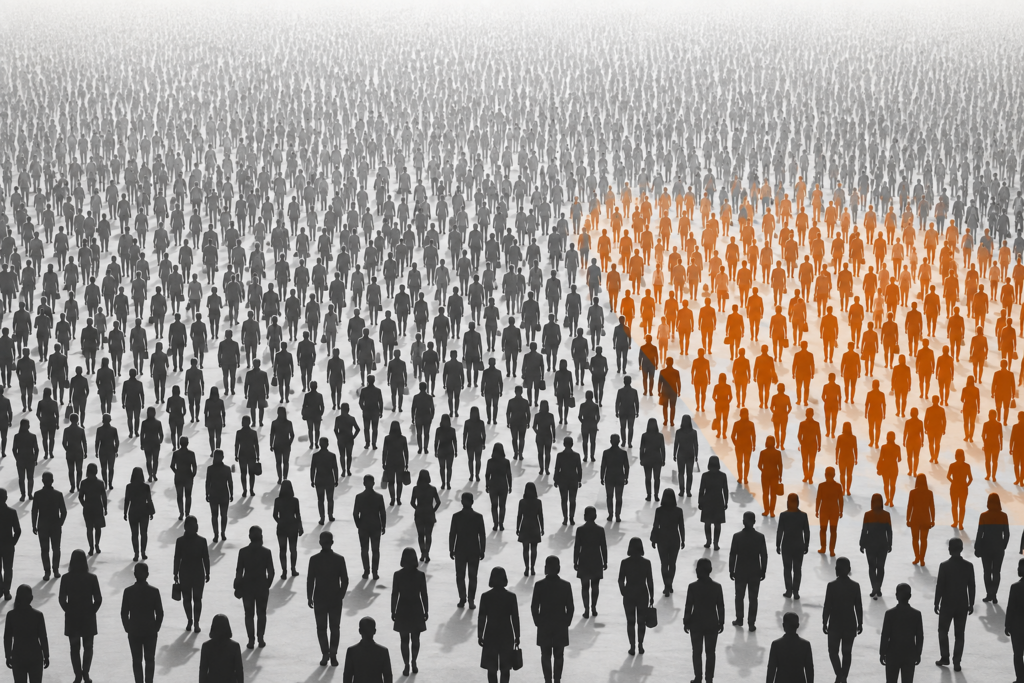
The Working Poor: America’s Invisible Workforce and the Representation Gap
Millions of Americans do exactly what society tells them to do: they work. They show up, clock in, care for children, stock shelves, serve meals, clean buildings, drive deliveries, and keep essential services running. Yet many remain poor despite their participation in the workforce.
The ‘working poor’ occupy a difficult place in American public life. They are neither unemployed nor entirely disconnected from the economy. They are workers. Yet questions remain about whether their interests are adequately represented in political decision-making, public policy, and legislative priorities.
What Does It Mean to Be “Poor” in the United States?
In the United States, poverty is measured using the Official Poverty Measure (OPM) established by the U.S. Census Bureau. They compare a family’s annual income to a set of poverty thresholds that vary by family size and composition. If a family’s total income falls below its designated threshold, every member of that family is considered to be living in poverty.
The U.S. Census Bureau reported that 35.9 million Americans, or 10.6% of the population, lived below the federal poverty threshold in 2024.
[irp.wisc.edu], [bls.gov]
The Census Bureau notes that these thresholds are intended to serve as a statistical yardstick, not as a complete measure of what families actually need to live comfortably in different parts of the country.
Who Are the Working Poor?
The term “working poor” is not just a political slogan. The U.S. Bureau of Labor Statistics (BLS) maintains an official definition.
According to the BLS, the working poor are individuals who spent at least 27 weeks during the year in the labor force (either working or looking for work) but whose incomes still fell below the federal poverty threshold. [bls.gov], [bls.gov]
In other words, these are people who are meaningfully attached to the workforce but remain poor despite that effort.
How Many Working Poor Americans Are There?
The most recent BLS profile found that:
- Approximately 6.1 million Americans were classified as working poor in 2023. [bls.gov]
- The working-poor rate was 3.8% of all people who participated in the labor force for at least 27 weeks. [bls.gov]
- Full-time workers were substantially less likely to be working poor than part-time workers. Among those attached to the labor force for at least 27 weeks, 2.4% of full-time workers were classified as working poor compared with 9.4% of part-time workers. [bls.gov]
These figures challenge a common assumption that poverty is primarily associated with not working. Millions of people work consistently and still struggle to achieve economic security.
What Does the Working-Poor Population Look Like?
Research from the Center for Poverty and Inequality Research, based on Bureau of Labor Statistics data, reveals important demographic patterns. In 2022:
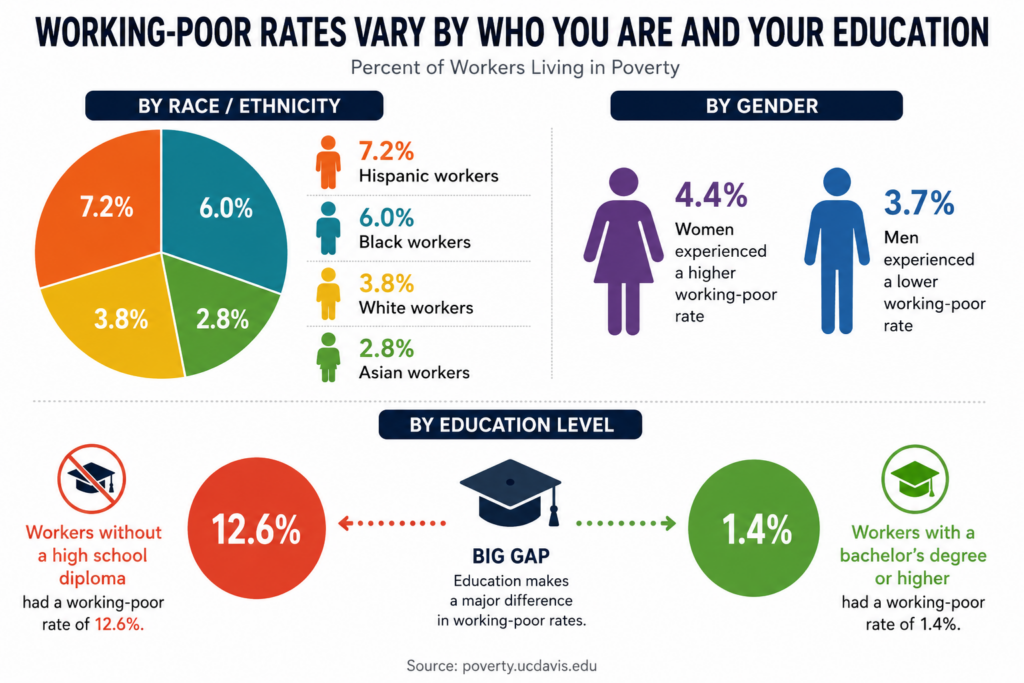
While the working poor are often discussed as a single group, they are incredibly diverse. They include retail workers, home-health aides, food-service employees, childcare providers, agricultural workers, gig workers, and many others whose labor is essential to everyday life.
Are the Working Poor Even Represented?
The answer depends on how we define representation.
The working poor are represented in the formal sense. They vote, have elected officials, and are affected by legislation passed at every level of government.
The more difficult question is whether their preferences and interests have influence that is proportionate to their numbers.
A growing body of research suggests that the answer may be no.
Evidence of Systematic under-representation
1. Law and Policy Outcomes Tend to Track the Preferences of Wealthier Americans
Political scientist Martin Gilens conducted influential research examining whether government policy reflects the preferences of Americans at different income levels.
His findings were striking.
When affluent Americans and lower-income Americans disagreed on policy issues, policy outcomes “strongly reflect[ed] the preferences of the most affluent” while bearing “virtually no relationship” to the preferences of poor or middle-income Americans. [princeton.edu], [academic.oup.com]
Gilens concluded that these disparities raise serious questions about political equality in the United States. [princeton.edu], [academic.oup.com]
While scholars continue to debate the magnitude of this effect, the research remains one of the most cited pieces of evidence that economic inequality can translate into unequal political influence.
2. Lower-Income Americans Participate Less in Politics
Another challenge is participation.
Recent research examining working-class and low-income Americans found that these groups vote at lower rates than more affluent citizens and that participation has declined among some segments of the population. [The political…n What …], [scholars.org]
Researchers found that many low-income Americans view politics as:
- disconnected from their daily lives,
- dominated by wealthier and more educated people,
- incapable of producing meaningful change,
- and insufficiently interested in helping their communities.
This creates a troubling feedback loop: communities that feel ignored, participate less, and lower participation can reduce their influence over policy decisions.
2. Lower-Income Americans Participate Less in Politics
Another challenge is participation.
Recent research examining working-class and low-income Americans found that these groups vote at lower rates than more affluent citizens and that participation has declined among some segments of the population.
Researchers found that many low-income Americans view politics as:
- Disconnected from their daily lives,
- Dominated by wealthier and more educated people,
- Incapable of producing meaningful change,
- Insufficiently interested in helping their communities.
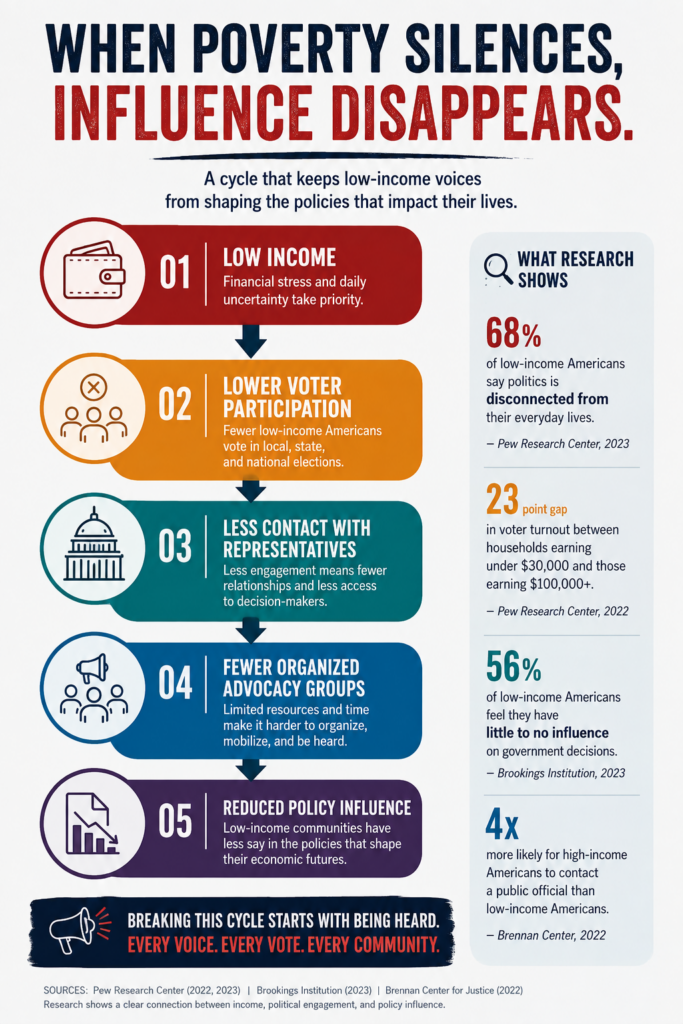
This creates a troubling feedback loop: communities that feel ignored participate less, and lower participation can reduce their influence over policy decisions.
3. The Working Poor Often Lack Powerful Advocacy Structures
Many working-poor Americans work in industries with relatively low unionization rates, including retail, hospitality, domestic work, agriculture, and gig work.
Historically, labor unions served as major institutions through which workers could exercise collective political power. However, many low-wage workers today do not belong to unions and therefore lack a direct organizational vehicle for policy advocacy.
Various worker-rights organizations and community groups attempt to fill this gap, but they generally possess fewer resources and less lobbying influence than major corporations and industry associations. [philanthropic…gether.org], [workingamerica.org], [social just…center.org]
The Policy Blind Spot
Perhaps the most interesting aspect of the working-poor debate is that the group often falls between traditional policy categories.
Public discussions frequently separate Americans into groups such as workers, unemployed people, welfare recipients, middle-class taxpayers, retirees, etc.
The working poor fit none of these categories neatly because they are working, yet struggling financially. As a result, their challenges can be overlooked in systems designed around assumptions that employment alone should provide economic security.
Affordable Housing
Healthcare Access
Work Schedules
Transportation
Stagnant Wages
Childcare Costs
These issues often affect the working poor more intensely than other groups, yet these concerns do not always dominate legislative agendas.
A Fair Counter Argument
It would be inaccurate to claim that the working poor are completely ignored. Many policies were specifically designed to support low-income workers, including:
- The Earned Income Tax Credit
- Minimum wage laws
- Medicaid expansions in some states
- Child tax credits
- Housing assistance programs.
These policies demonstrate that lawmakers have, at times, responded to the needs of lower-income workers. The real debate is not whether the working poor have any representation, but whether that representation is proportional to their numbers and economic importance.
An Essential Workforce with a Limited Voice
The working poor represent one of America’s most overlooked populations. They challenge a deeply held assumption that employment alone is enough to achieve financial stability.
Research suggests that lower-income Americans often face barriers to political representation and influence, including lower civic participation, fewer organized advocacy structures, and policy environments that may be more responsive to wealthier Americans. [princeton.edu], [academic.oup.com], [The political…n What …], [scholars.org]
More than 6 million Americans worked or looked for work for at least 27 weeks in 2023 and still lived below the federal poverty line. Their experiences deserve greater visibility in public discussions about work, opportunity, and economic mobility. [bls.gov]
If we believe that work should provide a pathway to stability and dignity, then the voices of the working poor deserve a larger place in the conversations shaping America’s future.
What You Can Do
Understanding the challenges facing the working poor is only the first step. Here are five ways you can make a meaningful impact in your community and beyond.
Learn the Facts
Understanding of how poverty is defined, measured, and experienced by millions of working Americans.
Vote Informed
Research the effects of laws, candidates and policies that affect wages, housing, healthcare, childcare, and economic mobility.
Worker Support
Many organizations help low-income workers navigate workplace challenges and advocate for policy reforms. Get started below.
Get Involved & Educate
Support local initiatives focused on affordable housing, childcare, transportation, and workforce development for your community.
Spread Awareness
Many Americans are unaware that millions of people work and still live in poverty. Awareness can drive meaningful change.