

Corporate America
Corporate Profits, Working-Class Sacrifice
Companies have multiple ways to respond to financial pressure, but workers and consumers frequently bear substantial costs through higher prices, reduced benefits, wage restraint, and layoffs.
Capitalism has produced extraordinary innovation, economic growth, and opportunities for millions of Americans. Businesses need to earn profits. Investors take risks. Companies must compete, adapt, and remain financially sustainable. None of that is necessarily wrong…
But many times capitalism also creates incentives that deserve serious examination.
When American corporations succeed financially, how much of that success reaches the workers who helped create it—and when businesses face financial pressure, who absorbs the consequences?
There is substantial economic research on corporate profitability, productivity, wages, pricing decisions, layoffs, executive compensation, and workers’ bargaining power.
Companies take steps to protect profit margins before allowing profits to decline

In many corporations, labor is treated as a cost to be managed. When financial performance comes under pressure, companies may reduce staffing, limit wage increases, restructure benefits, automate jobs, or shift expenses onto consumers.
These decisions may be financially rational from a corporate perspective.
But what happens to the people affected by them?
A successful economy should create prosperity for those who worked so hard to create it… The Working Class!
An employee who has dedicated twenty years to a company can become a line item in a restructuring plan. A family struggling with healthcare costs can face higher premiums and deductibles. Consumers can absorb price increases while executives and investors continue evaluating whether returns are sufficient.
We should be able to ask the questions around these injustices without being accused of opposing business, innovation, or economic growth.
The illusion of shared prosperity
The familiar economic promise is that when companies become more productive and profitable, employees will benefit through higher wages, improved benefits, and greater financial security.
Why should economic productivity increase substantially while typical workers receive a smaller share of the gains?
According to the Economic Policy Institute (EPI), productivity grew approximately 2.7 times as much as typical workers’ compensation between 1979 and 2025. EPI estimates that a full-time worker earning the 2025 median wage of approximately $53,400 would have earned about $76,400 if their compensation had kept pace with productivity under its methodology.
Source: Economic Policy Institute, 2026. Counterfactual estimate, not unpaid wages owed.
Under EPI’s methodology, a full-time worker earning approximately $53,400 in 2025 would have earned about $76,400 if compensation had kept pace with productivity—a difference of roughly 43%!!!
40% more salary a year… What would that change for your family?
Productivity growth creates the potential for higher wages, but how the gains are distributed depends on bargaining power, labor markets, ownership, and public policy. Workers can produce more economic value per hour without receiving a proportional increase in compensation.
Protecting profit margins
When costs increase, how much do corporations pass on to consumers?
Researchers also found that maintaining steady profit margins was one of the most important considerations in business pricing decisions.
It provides direct evidence that protecting margins is an explicit part of corporate decision-making, rather than merely an assumption made by critics.
A June 2023 Federal Reserve Bank of New York research paper, using business survey responses collected in December 2022 and January 2023, found an average estimated cost-price pass-through of approximately 60%.
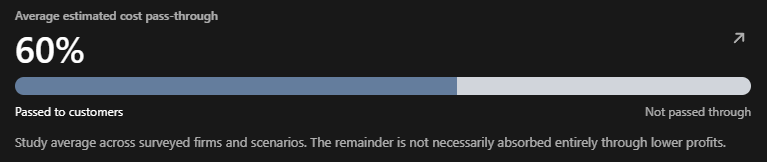
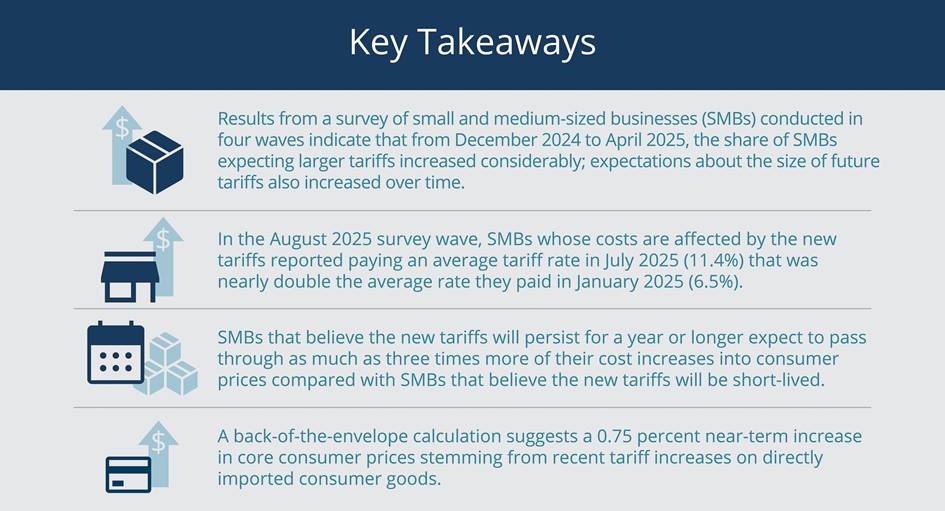
A more recent Federal Reserve Bank of Boston study found that, in April 2025, importing businesses expected to pass approximately two-thirds of anticipated cost increases to customers over the following year. This was a survey of expectations, not verified final price changes.
The Passthrough of Tariffs –
Workers are an adjustable expense
When companies need to reduce expenses, or protect their profits, what happens to the people doing the work?
Labor is an operating expense, but employees experience reductions in staffing and compensation very differently from ordinary accounting adjustments.
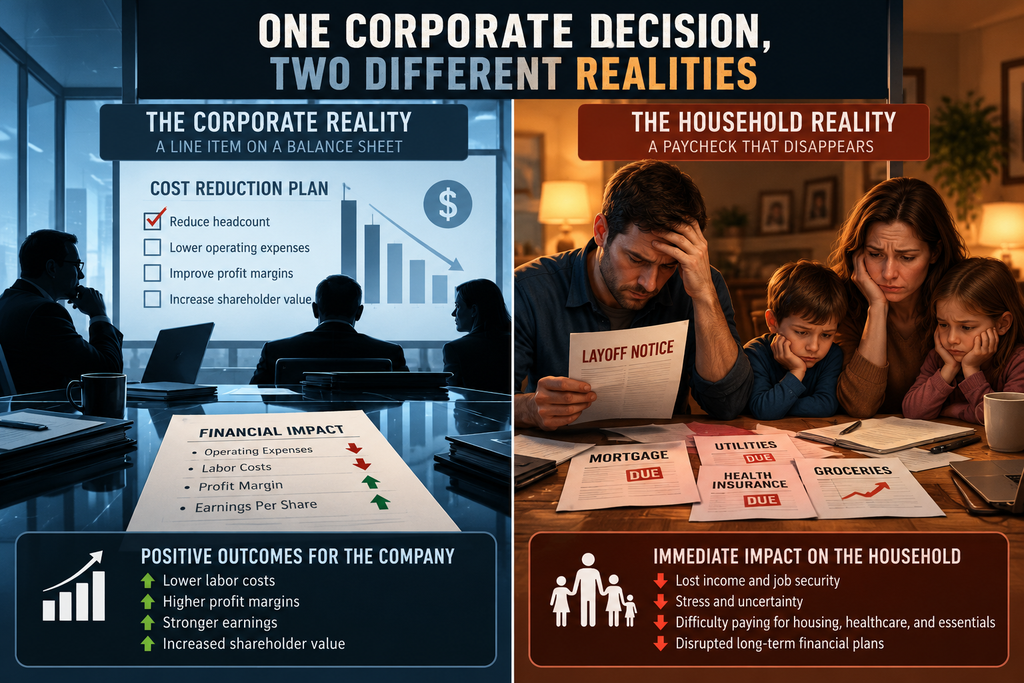
Federal Reserve research on employment decisions indicates that employers sometimes favor layoffs over reducing wages when revenues decline. Wage reductions can create retention and morale problems, while layoffs allow employers to adjust staffing more directly.
Another significant pressure is healthcare. Employer-sponsored health insurance represents a substantial component of total compensation paid by firms to many workers in the United States.
A March 2026 New York Fed examined how increasing benefit expenses influence wage-setting decisions. They reported that average annual employer-sponsored family health insurance premiums reached approximately $27,000 in 2025, which is roughly equivalent to the wage of a full-time worker making $15 per hour!! Further, costs have climbed by close to 20 percent over the past five years.
We produce the goods and services, but we also purchase them
How can workers achieve financial security when they face pressure on both sides of their household budget? Workers can experience financial pressure both when earning money and when spending it.
The data
The Federal Reserve’s 2025 household financial survey, released in May 2026, found:
37%
Could NOT cover a $400 emergency entirely with cash or its equivalent
26%
Skipped some medical expenses because of cost in the past year
59%
Experienced at least one major unexpected expense in the prior year
65%
Of non-retirees believed their retirement savings were NOT on track
Source: Federal Reserve, 2025 Survey of Household Economics and Decision making. These figures describe U.S. adults or non-retirees, not exclusively working-class households.
The working class families depends on wages, while also depending on affordable goods and services. So even a nominal wage increase may provide little to no relief if essential household costs increase faster.
However, financial pressure isn’t limited to reduced purchasing power; it can affect healthcare decisions, family stability, and long-term planning.
Further, higher prices can reduce the ability to build emergency savings, increases our ability to cover layoffs or medical bills.
Who really profits? Executives, shareholders, and workers
Workers may bear the consequences of corporate decisions without having comparable influence over them. Which means corporate financial success does not necessarily produce equal financial benefits.
The Economic Policy Institute’s September 2026 analysis estimates that CEOs of large U.S. companies received approximately 325 times the annual compensation of typical workers in their industries in 2025, using realized compensation. This measure includes stock-related compensation and reflects a specific sample of large companies, not all American businesses.
Shareholder Distributions – a substantial difference in who owns financial assets.
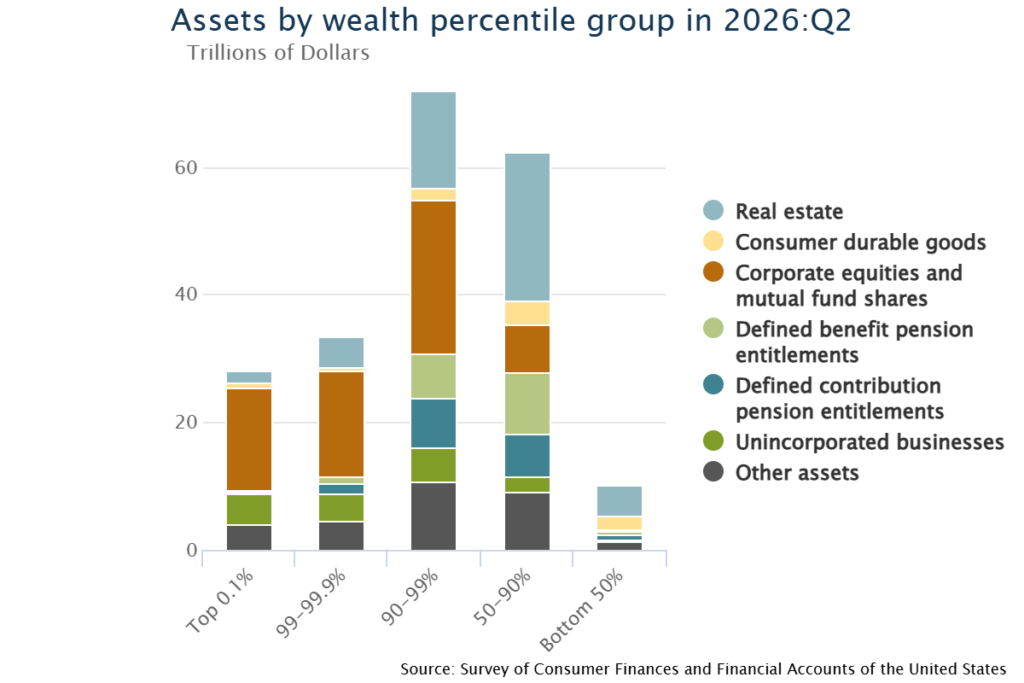
Federal Reserve Distributional Financial Accounts data for the first quarter of 2026 show that the top 10% of households by wealth held approximately 88% of corporate equities and mutual fund shares, while the bottom 50% held roughly 1%. These are wealth-percentile groups, not a direct classification of working-class employment.
S&P 500 companies, calendar year 2024
$1.57 trillion
Share buybacks and dividends combined
$942.5B
Share buybacks
$629.6B
Dividends
Source: S&P Dow Jones Indices, March 2025. S&P Dow Jones Indices
Dividends and share repurchases distribute financial value to investors, but the benefits depend on who owns corporate stock. Workers can participate in stock-market gains through retirement accounts, although ownership is distributed unequally. When companies simultaneously argue that labor costs or employee benefits are unaffordable, it makes sense that large shareholder distributions deserve additional scrutiny.
If employees contribute to corporate success, are the financial rewards distributed in a way that fairly recognizes their contributions?
Who decides? The unequal power workers have over corporate decisions
Corporate boards and executives have formal authority over major business decisions and governance, so workers may bear the consequences of corporate decisions without having comparable influence over them.
And the bad news, what little influence we do have continues to shrink!
In the past, Collective bargaining (Unions) gave workers a stronger negotiating position on compensation, working conditions, and employment policies.
However, Union membership has declined considerably over several decades, particularly in the private sector.
The U.S. Bureau of Labor Statistics reported that union membership was 10.0% among wage and salary workers in 2025, compared with 20.1% in 1983.
In the private sector, just 5.9% of workers belonged to unions in 2025.
There is also a substantial difference in who owns financial assets.
The following data from the Federal Reserve Distributional Financial Accounts, for the first quarter of 2026 show that the top 10% of households by wealth held approximately 88% of corporate equities and mutual fund shares, while the bottom 50% held roughly 1%. These are wealth-percentile groups, not a direct classification of working-class employment.
The Question we need to ask:
Why do people whose livelihoods depend on corporate decisions often have less influence over those decisions than people whose primary stake is financial ownership?
Conclusion
The American economy depends on workers. They produce the goods, provide the services, support the customers, and help generate the revenue that keeps businesses operating. Yet the evidence raises difficult questions about how the rewards of that work are shared.
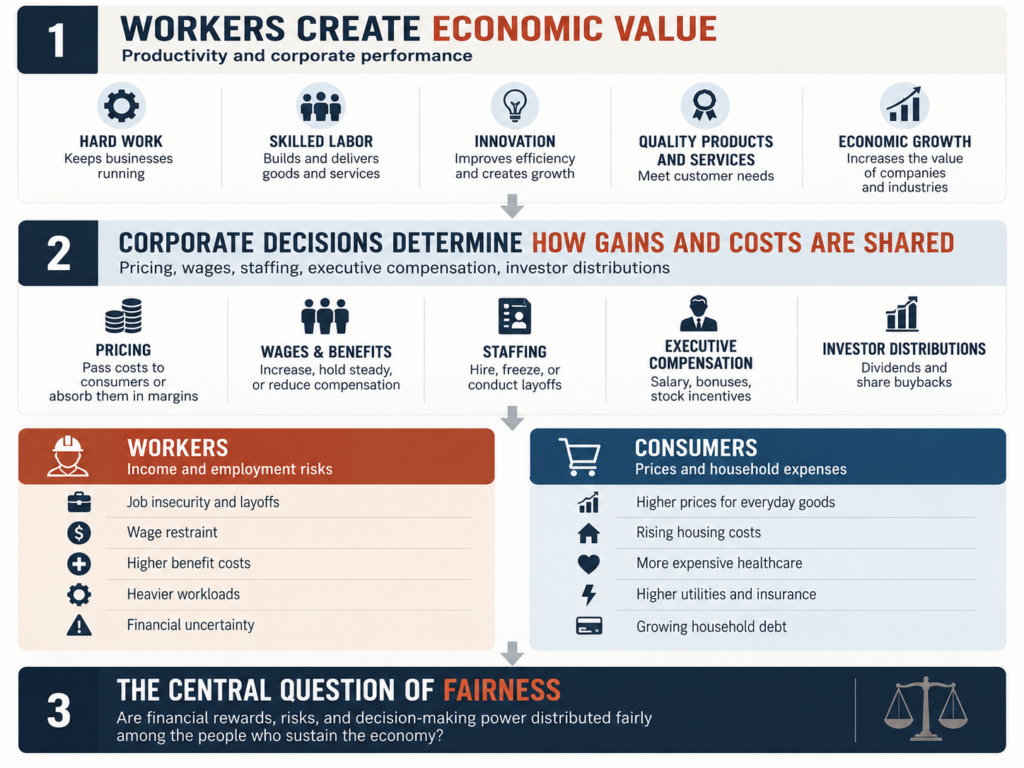
As we have seen, productivity has grown substantially faster than typical worker compensation over the past several decades. Businesses explicitly consider maintaining profit margins when setting prices. Executive compensation and shareholder distributions can reach extraordinary levels, while many households continue to struggle with basic financial security.
None of these facts necessarily proves that every company mistreats its employees or that every corporate financial decision is unjustified. But together, they raise a question worth asking:
If working Americans are essential to creating corporate prosperity, shouldn’t they have a meaningful share in its rewards—and a meaningful voice in how its sacrifices are distributed?

Like this post and interested in more content?
References
Abel, Jaison R., et al. “Are Rising Employee Health Insurance Costs Dampening Wage Growth?” Liberty Street Economics, Federal Reserve Bank of New York, 4 Mar. 2026, https://doi.org/10.59576/lse.20260304b.
Andrade, Philippe, et al. “Who Will Pay for Tariffs? Businesses’ Expectations about Costs and Prices.” Current Policy Perspectives, no. 25-13, Federal Reserve Bank of Boston, 29 Sept. 2025, https://www.bostonfed.org/publications/current-policy-perspectives/2025/who-pays-for-tariffs.aspx.
Bertheau, Antoine, et al. Why Firms Lay Off Workers Instead of Cutting Wages: Evidence from Linked Survey-Administrative Data. Federal Reserve Bank of San Francisco, 2025. Working Paper 2025-05. https://doi.org/10.24148/wp2025-05.
Bivens, Josh, et al. The Case for Tripling Union Membership: How Rebuilding Union Power Would Strengthen Workers, the Economy, and Our Democracy. Economic Policy Institute, 15 July 2026, https://www.epi.org/publication/the-case-for-tripling-union-membership-how-rebuilding-union-power-would-strengthen-workers-the-economy-and-our-democracy/.
Board of Governors of the Federal Reserve System. “Distribution of Household Wealth in the U.S. since 1989.” Distributional Financial Accounts, 18 Sept. 2026, https://www.federalreserve.gov/releases/z1/dataviz/dfa/distribute/chart/. Accessed 22 Oct. 2026.
Board of Governors of the Federal Reserve System. Economic Well-Being of U.S. Households in 2025. May 2026, https://www.federalreserve.gov/publications/files/2025-report-economic-well-being-us-households-202605.pdf.
Dogra, Keshav, et al. Estimates of Cost-Price Passthrough from Business Survey Data. Federal Reserve Bank of New York, June 2023. Staff Report no. 1062. https://www.newyorkfed.org/research/staff_reports/sr1062.html.
Economic Policy Institute. “The Productivity–Pay Gap.” https://www.epi.org/productivity-pay-gap/. Accessed 22 Oct. 2026.
Gould, Elise, and Josh Bivens. “CEO Pay Surged in 2025: CEOs Are Paid 325 Times as Much as the Typical Worker.” Working Economics Blog, Economic Policy Institute, 17 Sept. 2026, https://www.epi.org/blog/ceo-pay-surged-in-2025-ceos-are-paid-325-times-as-much-as-the-typical-worker/.
S&P Dow Jones Indices. “S&P 500 Q4 2024 Buybacks Increase 7.4% and 2024 Expenditure Sets New Record by Increasing 18.5%; Earnings Per Share Increases from Buybacks Decline for the Quarter, as Q1 2025’s Impact Is Expected to Increase.” S&P Global, 19 Mar. 2025, press release.
United States, Department of Labor, Bureau of Labor Statistics. “Union Members—2025.” 18 Feb. 2026, https://www.bls.gov/news.release/union2.nr0.htm. Accessed 22 Oct. 2026.






One Comment