

When survival becomes a full-time job, standing up for yourself can become a luxury.
Millions of Americans feel squeezed by the cost of everyday life. This article examines how that pressure can limit the time, security, and energy people have to challenge the institutions shaping their lives.
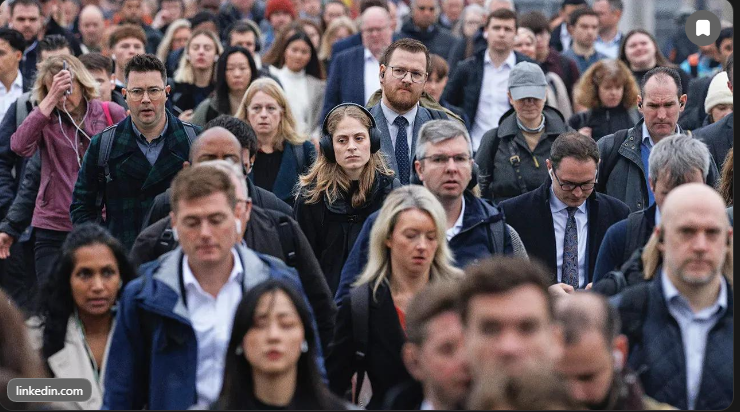
The American pressure cooker
Get a job. Work hard. Pay your taxes. Buy a home. Raise a family. Save for retirement.
That’s the American Dream, right? The working class have been sold this line for generations. But somewhere along the way, the deal started to feel different.
Today, millions of Americans work full-time yet struggle to afford housing, healthcare, groceries, insurance, and other basic necessities. People are working longer, cutting expenses, taking on debt, and postponing major life decisions just to maintain some sense of financial stability.
Meanwhile, corporations report record profits, executive compensation packages can reach extraordinary levels, and our local and federal government continue spending billions on programs and projects that many taxpayers struggle to understand or influence.
What the numbers show
In October 2026, Pew Research Center found that 73% of Americans were very concerned about the cost of food and consumer goods. A separate survey found that 53% were more financially stressed than a year earlier. And among Americans living paycheck to paycheck, 71% said a one-week delay in receiving their pay would create major financial hardship or an emergency.
According to the Federal Reserve’s 2025 household financial survey, 91% of American adults expressed some level of concern about price increases, and 58% said price changes over the previous year had made their financial situation worse.
The same survey found that 37% of adults could not cover a hypothetical $400 emergency expense entirely with cash or its equivalent.
Source: Federal Reserve, household financial well-being in 2025.
Americans are becoming more financially stressed
A July 2026 CNBC/SurveyMonkey study provides another compelling set of findings.
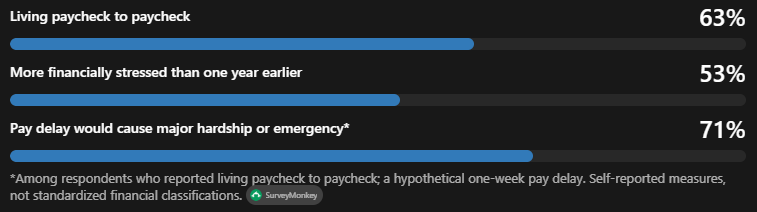
These numbers reveal an important point: A person can be doing well financially and still feel that the economic system is becoming increasingly difficult to navigate.
Who absorbs the costs?
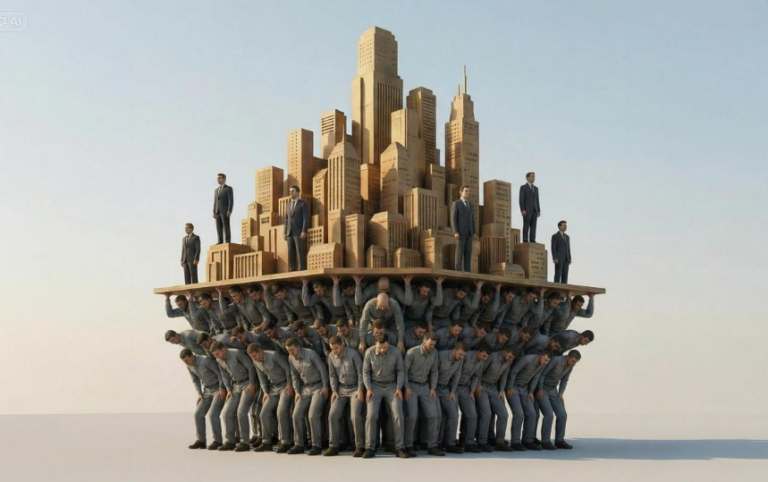
The working class has become America’s financial shock absorbed.
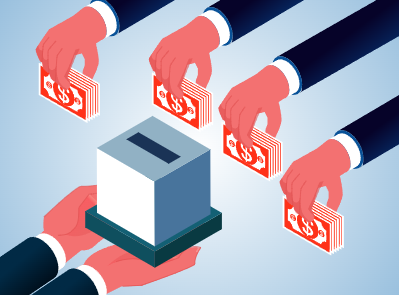
America’s economic system creates a troubling paradox. Workers are expected to remain productive, absorb increasing living expenses, support government through ever-increasing taxes, and also cover any personal financial emergencies all alone. Yet the economic security we need to challenge these unfair conditions is often missing.
What’s worse, those we rely on most to protect us from working class injustices, the companies we work for and our own government, are actually ADDING to our financial burden and stress.
Here’s Why…
Corporate decisions
When protecting profit comes before protecting people
Who absorbs the financial consequences when businesses face pressure to their profits, stakeholders, and bottom line? I think most of us already know the answer…
Capitalism has produced extraordinary innovation, economic growth, and opportunities for millions of Americans. Businesses need to earn profits. Investors take risks. Companies must compete, adapt, and remain financially sustainable. None of that is necessarily wrong…
But many times capitalism also creates incentives that deserve serious examination.
In many corporations, labor is treated as a cost to be managed. When financial performance comes under pressure, companies may reduce staffing, limit wage increases, restructure benefits, automate jobs, or shift expenses onto consumers.
These decisions may be financially rational from a corporate perspective.
But what happens to the people affected by them?
See more in depth Information:
Capitalism – When protecting Profit Comes Before Protecting People
Government decisions
Corporations aren’t the only institutions that deserve scrutiny. Our very own Government does too, perhaps more than corporations!
Federal, state, county, and municipal governments all collect taxes and fees to fund public services, infrastructure, schools, healthcare etc. Obviously, these services matter because they contribute to public safety, economic opportunity, and our Overall quality of life.
But not all taxes we pay cover what we think. These same agencies make spending, borrowing, and taxation decisions that can create long-term obligations for households. Working Americans deserve accountability for how those decisions affect their financial security.
When elected officials approve spending beyond current revenues, they can finance the difference through debt. Borrowing can be justified for emergencies, recessions, and productive long-term investments. But persistent deficits also generate interest costs and difficult future budget decisions.
Weather or not you think capitalism or government has intentionally designed a system to keep workers silent, it does raise questions as to why this system seems to keep us just poor enough, and just tired enough, that we won’t take action. Especially when these entities benefit so greatly when we don’t.
See more in depth Information:
Is the Working Class – Government’s Financial Safety Net?
The cost of standing up
So why not organize? Why not walk out? Why not demand something better?
Imagine you’re a full-time employee earning just enough to cover your monthly expenses. Your mortgage or rent is due. Your car payment is due. Groceries are expensive. Your family depends on your health insurance.
You believe your employer should pay better wages. You believe executives are rewarded disproportionately. You believe the people doing the everyday work deserve greater consideration.
What happens if standing up to injustice ends up in you losing your job?
For many Americans, losing employment doesn’t simply mean losing a paycheck. It can mean losing health insurance, falling behind on housing payments, accumulating debt, and jeopardizing the financial security of an entire family.
And even when collective workplace activity is legally protected, workers may still worry about lost income, strained relationships, and uncertain outcomes.
The most unjust part of the system – The people who are most unfairly effected, those who want to challenge this system most, are also those that depend on the system to survive.
This creates a disturbing contradiction…
We’re told as Americans that we have the freedom to stand up for ourselves. But how free do do we feel when exercising that “freedom” could cost us our livelihood?
To be clear, workers do have important legal rights. The National Labor Relations Act protects many forms of collective workplace activity, including certain strikes by nonunion employees. But protections depend on the circumstances, and not every walkout is legally protected.
But, the fear of losing financial security can still be too powerful an influencer even when workers have legal protections. And when you’re already struggling to pay the bills, taking a risk for a better future can feel impossible.
The invisible costs of insecurity
When people are too busy surviving, how much energy remains for changing the system?
In 2026, the majority of American workers can (and should) be furious about rising costs, working class injustices, and political indifference— yet still spend the evening sorting bills or worrying about the future, instead of attending a community meeting.
That does not mean we are indifferent. It may mean we don’t have the financial, emotional, and psychological energy and/or means to comfortably absorb lost wages, transportation, childcare, psychological stress, or any other demands on an already exhausting day.
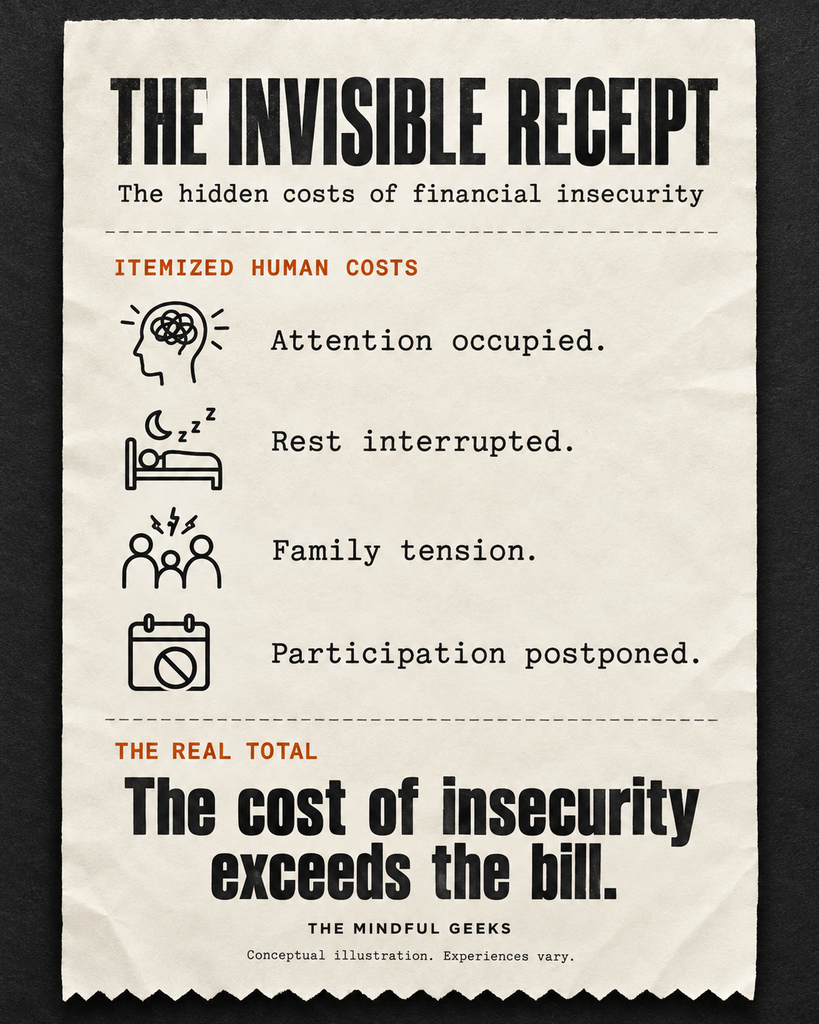
Middle class injustice reaches beyond the bank account. It can narrow the time, attention, and freedom people have to challenge the conditions making their lives harder.
For example, Financial strain can spill into relationships, too. In the American Psychological Association’s 2023 U.S. survey, 58% of parents reported that money was a cause of fights in their family, compared with 30% of other adults. Those responses illustrate how economic pressure can enter the home as conflict, not simply an unpaid balance.
Other Invisible Costs:
Scarcity and cognitive bandwidth
Financial stress can consume attention and make long-term planning more difficult, although its effects vary by context.
Collective-action problems
People may want a shared outcome but hesitate to participate when the personal costs are immediate and the benefits uncertain.
Political efficacy
People who believe institutions are unresponsive may become less willing to participate in conventional political processes.
These barriers do not affect everyone in the same way. Economic hardship can discourage some forms of participation while motivating others.
This is why working-class injustice cannot be measured only in dollars. We should also ask what happens to people’s attention, family life, rest, and ability to take part in decisions affecting them.
But, a meaningful voice should not depend on having money, time, and energy left over after survival.
How political division weakens accountability
Partisan loyalty can become a barrier to accountability when citizens scrutinize one another more fiercely than they scrutinize power.
People can share concerns about economic security and political influence while partisan hostility makes cooperation harder.
But American politics tends to fuel fear and division, encouraging people to see political opponents— who can even be your family and neighbors—as enemies. Meanwhile, lobbyists, wealthy donors, corporations, and special interests maintain influence through political spending and the revolving door between government and industry.
Ask Yourself –
“Who is more likely to understand the daily struggles I face—my neighbors, friends, and family, or wealthy and powerful people who have never even experienced many of these struggles?”
What collective power requires
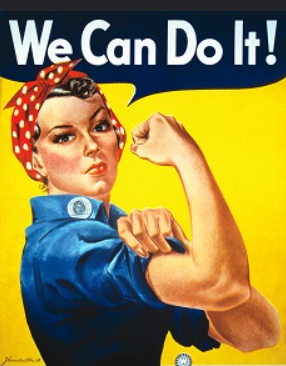
Anger can draw attention to a problem. Turning that attention into change takes organization, support, and a clear purpose.
The Montgomery bus boycott offers one example. The peaceful, coordinated protest lasted 381 days. Its endurance shows how collective action can depend on sustained participation rather than a single moment of outrage. The National Archives documents the boycott and its history.
Workplace organizing and consumer advocacy offer other ways for people to pursue shared goals. The appropriate approach depends on the issue, the people affected, and the risks they can reasonably carry.
Make participation possible
A useful starting point is a specific demand: what should change, who can change it, and how will people know whether progress has been made? Credible leadership, transparent decisions, and practical support can help people stay involved.
That support might mean childcare during meetings, transportation, accessible meeting times, or sharing the work so the same few people do not carry every responsibility. Boycotts and strikes can also affect workers and small businesses, so those consequences belong in the planning.
Workplace actions also require an understanding of applicable protections and limitations. The National Labor Relations Board explains employee rights and the right to strike.
Is silence really a choice?
When speaking up could put your income, health insurance, or housing at risk, silence can feel like the only affordable option. That fear deserves to be understood.
But understanding why people hesitate should also change how we invite them to participate. A movement that asks exhausted people to take on more risk needs to offer more than outrage. It needs a clear goal, practical support, and a credible reason to believe their effort matters.
A meaningful voice should not depend on having money, time, and energy left over after survival.

Like this post and interested in more content?
Sources and further reading
Federal Reserve — Economic Well-Being of U.S. Households in 2025. Household financial conditions and economic concerns.
American Psychological Association — Stress in America 2023. Stress, family responsibilities, and financial pressure.
National Labor Relations Board — Employee Rights and The Right to Strike.
National Archives — Rosa Parks and the Montgomery bus boycott.

One Comment