
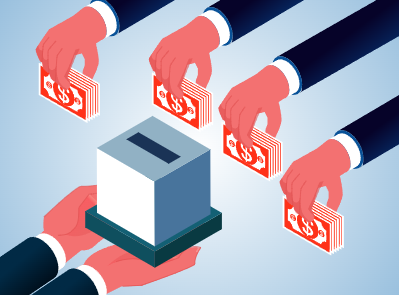
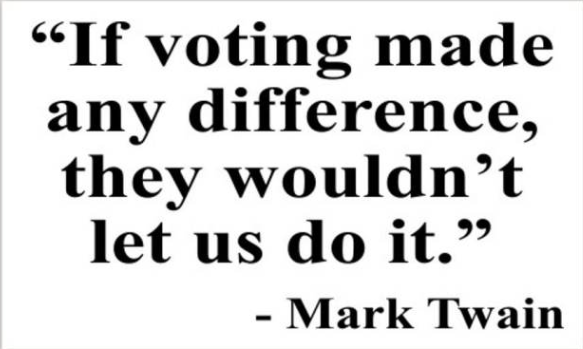
American elections don’t need baseless accusations of voter fraud. Elections can be, and ARE being, distorted legally through money, influence, incumbency, lobbying, Super PACs, media control, and campaign financing. These systems give disproportionate political power to a tiny percentage of wealthy donors.
Every citizen gets one vote. Not every citizen gets the same influence.
For the last few election cycles, there has been an ongoing debate in our house. My wife and I have voted in every election since we became eligible, and voting has always felt like an important civic responsibility.
As the November midterms approach, however, I find myself questioning whether I should continue participating in a system that I increasingly believe is fundamentally flawed and does not accurately reflect the will of the people.
My wife’s response, which is shared by many others, is that voting is the only way to elect the officials who can reform and improve those flawed systems. My view is becoming different. If an election is unfair or unrepresentative from the start, why should I participate in it at all?
Here’s what I mean.
Election Manipulation Doesn’t Always Mean Voter Fraud
When most Americans hear the phrase election rigging from our government officials and media outlets, they typically think of actions that directly manipulate the vote itself:
Influence before Election Day
Ballot counting and campaign communication are different parts of an election. Research examines how advertising, media exposure, and message framing affect voter attitudes before ballots are cast.
- Campaign reach. Funding pays for advertising and voter outreach, giving campaigns and outside groups resources to communicate with voters.
- Message testing. Campaigns use experiments to compare advertisements and identify more persuasive messages. An American Political Science Review study of campaigns own experiments examines the benefits of this testing.
- Media attention. Agenda-setting research examines how media coverage relates to the issues audiences consider important. A study of agenda-setting and campaign finance considers this relationship in election communication.
Campaign finance: the essential distinction
Contributions to federal candidates are subject to limits. Super PACs may accept unlimited contributions for independent expenditures but do not contribute directly to candidates. FEC guidance on PACs and Super PACs.
How independent is “independent spending”?
The FEC uses a three-part test—payment, content, and conduct—to determine whether a communication is coordinated. Shared consultants or former campaign staff do not automatically establish prohibited coordination; the circumstances and use of campaign information matter. FEC coordination rules.
The rules also provide a safe harbor for publicly available information under several conduct standards. That means legal independence does not require isolation from the wider political environment, but public information does not exempt every form of interaction from coordination rules. FEC guidance on publicly available information.
Is legal independence the same thing as practical independence?
A Small Number of Americans Fund a Large Share of Politics
Millions of Americans make small political donations, but a handful of wealthy contributors can outweigh them. In the 2022 federal election cycle, just 21 individuals and couples supplied $783 million—more than at least 3.7 million small donors combined. The top 100 donors and their spouses gave approximately 60% more than all small donors. Brennan Center
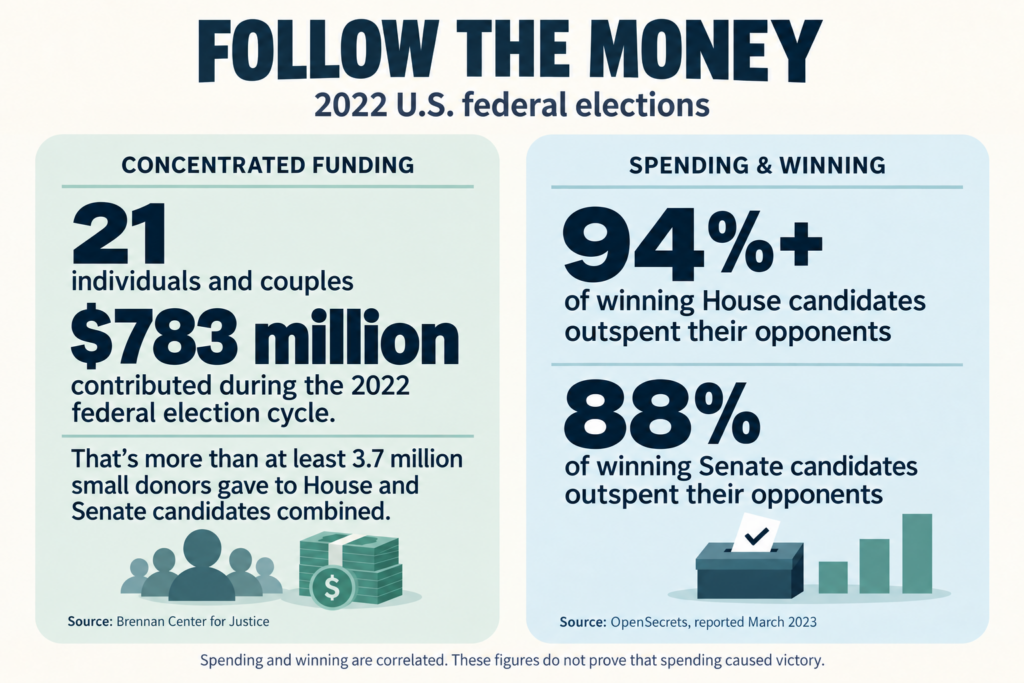
Examples of Mega-Donor election spending.
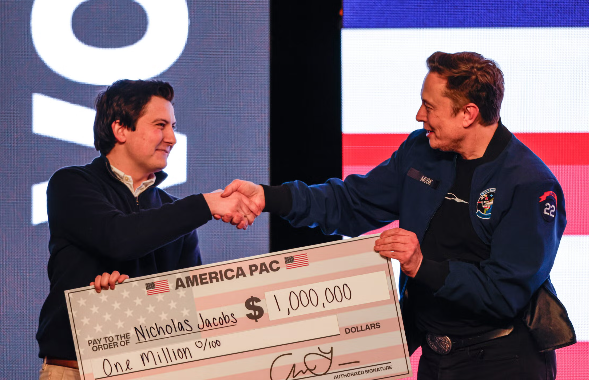
A December 2024 reporting put Musk’s political contributions at roughly $277 million, largely through America PAC. (CBS News analysis of campaign-finance filings.)
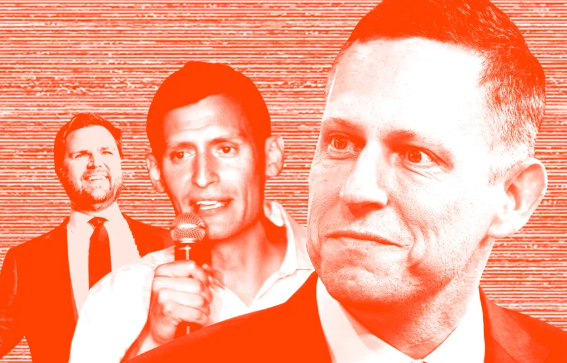
Further, Peter Thiel supplied $35 million to support the 2022 Senate bids of J. D. Vance and Blake Masters. Vance won; Masters lost. So the two different results show that this financial backing did not guarantee victory. (Brennan Center research report)
Does Money Buy Elections
What Funding Enables
What Funding Can’t Guarantee
The Incumbency Advantage
For Politicians seeking re-election (Incumbents), the next campaign begins with advantages a challenger must build from scratch: public visibility, established donor relationships, and a record they can use to rally supporters. Challengers must introduce themselves to voters while raising the money to reach them.
Why Incumbents Raise More Money
Existing networks
Lobbyist access
Media exposure
Party support
Why Challengers Struggle
Low visibility
Less fundraising
Reduced media access
Less Mega Donor Access
However, this doesn’t make incumbents unbeatable. It does raise a question: how open is political competition when one candidate starts with a microphone and another must first find the money to buy one?
Money doesn’t always create power. Often, power attracts money.

Interested in knowing what candidates have raised so far?
Click HERE
The Representation Paradox
When politicians need Donors, PACs, Lobbyists, Billionaires before they need votes, who becomes their primary audience?
The evidence points to ACCESS.
In a randomized study of congressional offices, senior policymakers made themselves available three to four times more often when told that meeting attendees were campaign donors. Wealthy contributors cannot guarantee an election result, but they can finance enormous campaign operations—and donor status can open doors once officials are in office. Kalla and Broockman
Federal law limits contributions directly to candidates, but Super PACs may accept unlimited contributions to fund independent expenditures. Equal voting rights therefore coexist with substantial differences in the resources people can devote to election communication. FEC guidance
Voting rights, campaign spending, and access to elected officials are different dimensions of political participation. What does each reveal about how representation works?
Should political influence be measured by ballots alone, or by money and access as well?
Conclusion
American elections may be legally conducted, but political influence is not distributed equally. Wealthy donors, Super PACs, and entrenched political interests can exert out sized influence over who voters hear, what issues dominate campaigns, and ultimately who is most likely to win.
Americans don’t need to believe elections are stolen to question whether they are fair. The votes themselves may be counted honestly. The concern is whether a political system flooded with billions of dollars can truly provide equal influence to every citizen.
Election fraud undermines democracy from the outside. Financial capture may undermine it from within. And that is the debate Americans increasingly find themselves having today.

Like this post and interested in more content?
References
- Federal Election Commission. “Coordinated Communications.” FEC.gov, www.fec.gov/help-candidates-and-committees/candidate-taking-receipts/coordinated-communications/. Accessed 18 Sept. 2026.
- Federal Election Commission. “Limits on Contributions Made by Non-connected PACs.” FEC.gov, www.fec.gov/help-candidates-and-committees/making-disbursements-pac/contribution-limits-nonconnected-pacs/. Accessed 18 Sept. 2026.
- Federal Election Commission. “Raising: By the Numbers.” FEC.gov, www.fec.gov/data/raising-bythenumbers/. Accessed 18 Sept. 2026.
- Federal Election Commission. “Registering as a PAC.” FEC.gov, www.fec.gov/help-candidates-and-committees/registering-pac/. Accessed 18 Sept. 2026.
- Hewitt, Luke, et al. “How Experiments Help Campaigns Persuade Voters: Evidence from a Large Archive of Campaigns Own Experiments.” American Political Science Review, vol. 118, no. 4, Nov. 2024, pp. 2021–39. https://doi.org/10.1017/S0003055423001387.
- Ingram, Julia, and Steve Reilly. “Elon Musk Spends $277 Million to Back Trump and Republican Candidates.” CBS News, 6 Dec. 2024, www.cbsnews.com/news/elon-musk-277-million-trump-republican-candidates-donations/.
- Kalla, Joshua L., and David E. Broockman. “Campaign Contributions Facilitate Access to Congressional Officials: A Randomized Field Experiment.” American Journal of Political Science, vol. 60, no. 3, 2016, pp. 545–58. https://doi.org/10.1111/ajps.12180.
- The Media School Report. “Martin Paper on Campaigns, Social Media Set for Publication.” The Media School, Indiana University Bloomington, 25 Apr. 2016, mediaschool.indiana.edu/news-events/news/item.html?n=martin-paper-on-campaigns-social-media-set-for-publication.
- Vandewalker, Ian. Do Small Donors Cause Political Dysfunction? Brennan Center for Justice, 8 May 2024, www.brennancenter.org/media/12874/download/2024_05_Do%20Small%20Donors%20Cause%20Political%20Dysfunction_Insight_final.pdf.
- Vandewalker, Ian, and Mariana Paez. “4 Takeaways About Money in the Midterms.” Brennan Center for Justice, 16 Nov. 2022, www.brennancenter.org/our-work/analysis-opinion/4-takeaways-about-money-midterms.