

When government needs more money, why are working households expected to find room in budgets that are already stretched?
A higher tax bill. An added fee. A policy change that brings another expense. The mechanisms differ, but the question for the family paying is the same: Where is the money supposed to come from?
Working people can become government’s financial safety net when public decisions shift additional costs onto households without adequately considering their ability to pay. If government needs more resources, residents deserve to know why they are being asked to absorb the pressure, what alternatives exist, and whose interests the decision serves.
Schools, roads, emergency response, healthcare programs, and public infrastructure need funding. The fairness of that funding deserves just as much scrutiny as the need for it. A legitimate public purpose does not settle whether a particular burden is affordable or fairly distributed.
When Public Decisions Become Household Costs
Direct taxes, service fees, and costs arising from laws or regulations are different mechanisms. A tax raises public revenue; a fee may pay for a particular service; a legal requirement may create a private expense without adding money to the government’s budget. Each needs to be examined on its own terms, including the benefits it provides and who ultimately pays.
The broader accountability question is whether officials assess the cumulative pressure on working households before adding another obligation. People do not pay each bill in isolation: they pay it alongside housing, food, healthcare, transportation, and every other demand on their income.
Who benefits? Who pays? Who decides? Who is held accountable when things go wrong?
Property Taxes: When Your Home Gains Value—but You Don’t Gain Income
Your home’s value increased. Your paycheck didn’t. Your tax bill may still rise.

Property taxes offer a concrete example of the broader problem. For a retiree on a fixed income or a family stretching each paycheck, a higher bill can become a new household obligation even when there is no new income to cover it. A home can be worth more on paper without putting another dollar in the budget.
A homeowner may face a higher property-tax bill without receiving any additional income. Insurance, maintenance, utilities, and other housing expenses can add to that pressure. The concern is especially sharp for people whose incomes are fixed or growing slowly.
A 20% increase in assessed value does not automatically mean a 20% tax increase. Tax levies, rates, changes in other properties’ values, exemptions, and state rules all affect the final bill. The important question is how those decisions change what a household actually owes.
An increase in a home’s market value may become a financial benefit if the owner sells or borrows against it. Neither option makes the annual tax bill easier to pay from current income without a consequential household decision.
Renters Feel the Pressure, Too
Landlords may pass some property-tax expenses to tenants through higher rents, depending on market conditions. Renters can therefore experience the pressure without receiving a property-tax bill themselves—and generally cannot directly appeal the assessed value of the property they occupy.
The accountability question: How are local officials considering residents’ ability to pay, including homeowners on fixed incomes and renters already facing higher housing costs?
So What Exactly Are We Paying For?
Government budgets cover real responsibilities, including public safety, roads, infrastructure, employee compensation, and social services. A larger budget is not necessarily proof of waste, but have visibility into what changed, why it changed, and what benefit the additional spending is expected to deliver.
- Which spending increases support essential services, and which reflect discretionary choices?
- Are programs producing measurable results?
- Have officials explained the alternatives and their consequences?
- How will the proposed funding affect households with different incomes?
Borrowing Creates Obligations Beyond Today’s Budget

When elected officials approve spending beyond current revenues, they can finance the difference through debt. Borrowing can be justified for emergencies, recessions, and productive long-term investments. But persistent deficits also generate interest costs and difficult future budget decisions.
Federal finances differ from household budgets, and federal borrowing should not be treated as identical to state or local borrowing. More accountability questions whether the purpose, financing costs, risks, and expected public benefits have been explained clearly.
Public Money, Private Development
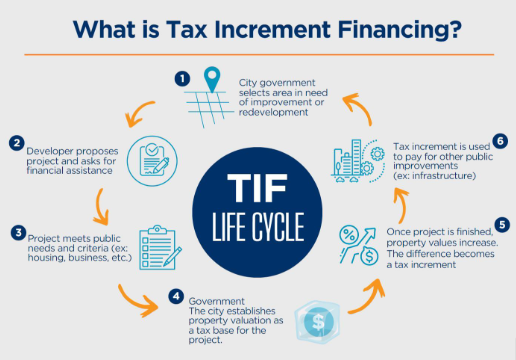
Local governments sometimes use tax increment financing (TIF), tax abatement’s, grants, and other incentives to attract businesses or development. These arrangements can support jobs, housing, and economic activity. They also deserve scrutiny when public resources support private interests.
- Did the project genuinely require public assistance?
- Were promised jobs, wages, housing, or other benefits delivered?
- Were alternative uses of the resources considered?
- Can residents review the agreement, performance measures, and consequences for missed commitments?
Public support should come with a clear explanation of the public benefit—and a way to check whether that benefit materializes.
When Does Spending Become Mismanagement?
A spending decision can be disappointing, inefficient, or poorly prioritized without being illegal. Using precise language makes criticism stronger and helps residents ask for the right evidence.
| Situation | What it means |
|---|---|
| Wasteful spending | Public funds used inefficiently or with limited value |
| Poor prioritization | Spending choices that neglect more important community needs |
| Weak oversight | Inadequate monitoring of contracts, programs, or results |
| Mismanagement | Deficient planning, controls, or administration |
| Misuse of funds | Spending that violates applicable restrictions or authorized purposes |
| Fraud or corruption | Deliberate deception, theft, bribery, or other unlawful conduct |
Questions about value call for budgets and performance data. Allegations of misuse or corruption require evidence about restrictions, controls, or unlawful conduct. Keeping those distinctions clear protects the credibility of the broader argument.
Who Gets Heard When Decisions Are Made?
Paying taxes and casting a vote do not necessarily give every person equal access to decision-makers. Research on political access helps explain why residents may question whose priorities receive attention.
Donors Can Receive Preferential Access
Joshua Kalla and David Broockman conducted a randomized field experiment involving meeting requests to 191 congressional offices. When offices were told that prospective attendees were political donors, senior policymakers made themselves available three to four times more often than when the attendees were described simply as constituents. (American Journal of Political Science in 2016. Wiley Online Library)
Because requests were randomly assigned, the experiment offered evidence that identifying attendees as donors did affect access to them. It does not establish that every meeting produced a policy favor or that the same result applies to every local government.
Policy Influence Is Unequal—and Debated
Martin Gilens and Benjamin Page’s widely cited 2014 study examined 1,779 proposed policy changes between 1981 and 2002. Their statistical analysis found substantial independent associations between policy outcomes and the preferences of affluent Americans and business-oriented interest groups. Average citizens’ preferences had little or no independent association after those other preferences were accounted for. Cambridge Core
Another analysis by Peter Enns argued that middle-income and affluent Americans’ policy preferences overlap enough that ordinary citizens receive more representation than sweeping interpretations of the original study imply. Researchers debate how best to measure whose preferences drive outcomes. Cambridge Core
The research raises a serious question about representation, while leaving room for debate about how influence should be measured. It does not prove that every tax increase or spending decision serves wealthy interests.
Why Accountability Gets Lost in Partisan Conflict
Holding officials accountable becomes harder when every criticism is treated as a victory for the opposing party. Attention incentives and partisan loyalty can both complicate scrutiny.
A 2021 study
analyzed 2.7 million Facebook and Twitter posts from news organizations and members of Congress. Posts referring to the opposing political group were shared approximately twice as often as posts referring to the speaker’s own group. References to political opponents were a stronger predictor of sharing than the other emotional-language measures the researchers examined. PMC
That finding identifies an attention incentive: emphasizing political opponents can attract more sharing. It does not establish a centrally organized effort to divide the public.
Matthew Graham and Milan Svolik’s 2020 study in the American Political Science Review used a nationally representative candidate-choice experiment and evidence from a congressional special election. They found that Americans’ willingness to prioritize democratic principles declined with stronger partisanship and other measures of polarization. Voters could trade those principles against party loyalty and preferred policies. Cambridge Core
That study examined democratic accountability rather than taxes or wages. Its relevance here is the mechanism: strong party loyalty can make voters less willing to discipline their own leaders.
A consistent standard would ask the same questions of every administration: What did you approve? Who benefits? What does it cost? What results can the public verify?
Shared Problems, Common Ground
A 2023 Pew survey found substantial agreement across party lines about political influence:
| View | Republicans and Republican leaners | Democrats and Democratic leaners |
|---|---|---|
| Large campaign donors have too much influence over Congress | 83% | 80% |
| People in lawmakers’ districts have too little influence | 72% | 71% |
| There should be limits on campaign spending by individuals and organizations | 71% | 76% |
These findings show that concern about unequal political influence crosses party boundaries. They measure public opinion, rather than independently proving how influence operates. Pew Research Center
Agreement about a problem offers a starting point for conversation; it does not automatically produce a coalition or agreement about solutions.
Financial strain and barriers to participation deserve their own discussion. Read The Hidden Cost of Survival: Why Americans Aren’t Fighting Back for more on the pressures that can make collective action difficult.
What Taxpayers Should Demand
Fair taxation is about more than the size of a bill. It is also about how the burden is distributed, what the money accomplishes, and whether the people paying have a meaningful voice. Federal taxes and transfers generally reduce measured income inequality, while some state and local taxes can place proportionately greater burdens on lower-income households.
Government should serve the public. That means making spending decisions understandable, showing results, and responding to reasonable questions before asking households to carry more.
- Find the proposal. Review your city or county’s proposed budget and property-tax levy, alongside the explanation of changes.
- Ask what drives the increase. Request the major spending changes, their purposes, and the alternatives considered.
- Follow subsidized projects. Ask for agreements, promised public benefits, progress reports, and enforcement provisions.
- Check available relief. Look up local and state property-tax relief, eligibility requirements, assessment-review procedures, and deadlines.
- Make the household impact visible. Ask officials how the proposal affects residents at different income levels, and bring those questions to a public budget hearing.
Government’s role as a safety net should be judged by how well it serves people. When households are asked to contribute more, they deserve a clear account of why—and a meaningful opportunity to question the decision.
Has your property-tax bill increased faster than your income—and did your local government clearly explain why? Share your experience in the comments.

Like this post and interested in more content?
Works Cited
Enns, Peter K. “Relative Policy Support and Coincidental Representation.” Perspectives on Politics, vol. 13, no. 4, 2015, pp. 1053–64. https://doi.org/10.1017/S1537592715002315. Cambridge Core
Gilens, Martin, and Benjamin I. Page. “Testing Theories of American Politics: Elites, Interest Groups, and Average Citizens.” Perspectives on Politics, vol. 12, no. 3, 2014, pp. 564–81. https://doi.org/10.1017/S1537592714001595. Cambridge Core
Graham, Matthew H., and Milan W. Svolik. “Democracy in America? Partisanship, Polarization, and the Robustness of Support for Democracy in the United States.” American Political Science Review, vol. 114, no. 2, 2020, pp. 392–409. https://doi.org/10.1017/S0003055420000052. Cambridge Core
Kalla, Joshua L., and David E. Broockman. “Campaign Contributions Facilitate Access to Congressional Officials: A Randomized Field Experiment.” American Journal of Political Science, vol. 60, no. 3, 2016, pp. 545–58. https://doi.org/10.1111/ajps.12180. Wiley Online Library
Pew Research Center. “Money, Power and the Influence of Ordinary People in American Politics.” Americans’ Dismal Views of the Nation’s Politics, 19 Sept. 2023. Read the report. pewresearch.org
Rathje, Steve, et al. “Out-Group Animosity Drives Engagement on Social Media.” Proceedings of the National Academy of Sciences, vol. 118, no. 26, 2021, article e2024292118. https://doi.org/10.1073/pnas.2024292118. PMC
Additional sources for the economic sections
Congressional Budget Office. The Distribution of Household Income in 2021. 11 Sept. 2024. Read the report.
Supports the discussion of federal taxes, transfers, and income distribution. Congressional Budget Office
Institute on Taxation and Economic Policy. Who Pays? A Distributional Analysis of the Tax Systems in All 50 States. 7th ed., 2024. Read the report.
Supports the discussion of how state and local tax burdens differ by household income. ITEP
League of Minnesota Cities. “Property Taxation 101.” 15 Sept. 2025. Read the explanation.
Provides Minnesota-specific context for levies, property values, and tax calculations. lmc.org
Minnesota Department of Revenue. 2026 Property Values and Assessment Practices Report. 13 Feb. 2026. Read the report.
Provides official background on Minnesota assessments and the relationship between property values and tax burdens. revenue.state.mn.us





One Comment